Potting Up Seedlings: When and How to Move Them
Learn when to pot up seedlings, how to separate and lift them without damage, what container size to use, and how to avoid mistakes that set plants back.
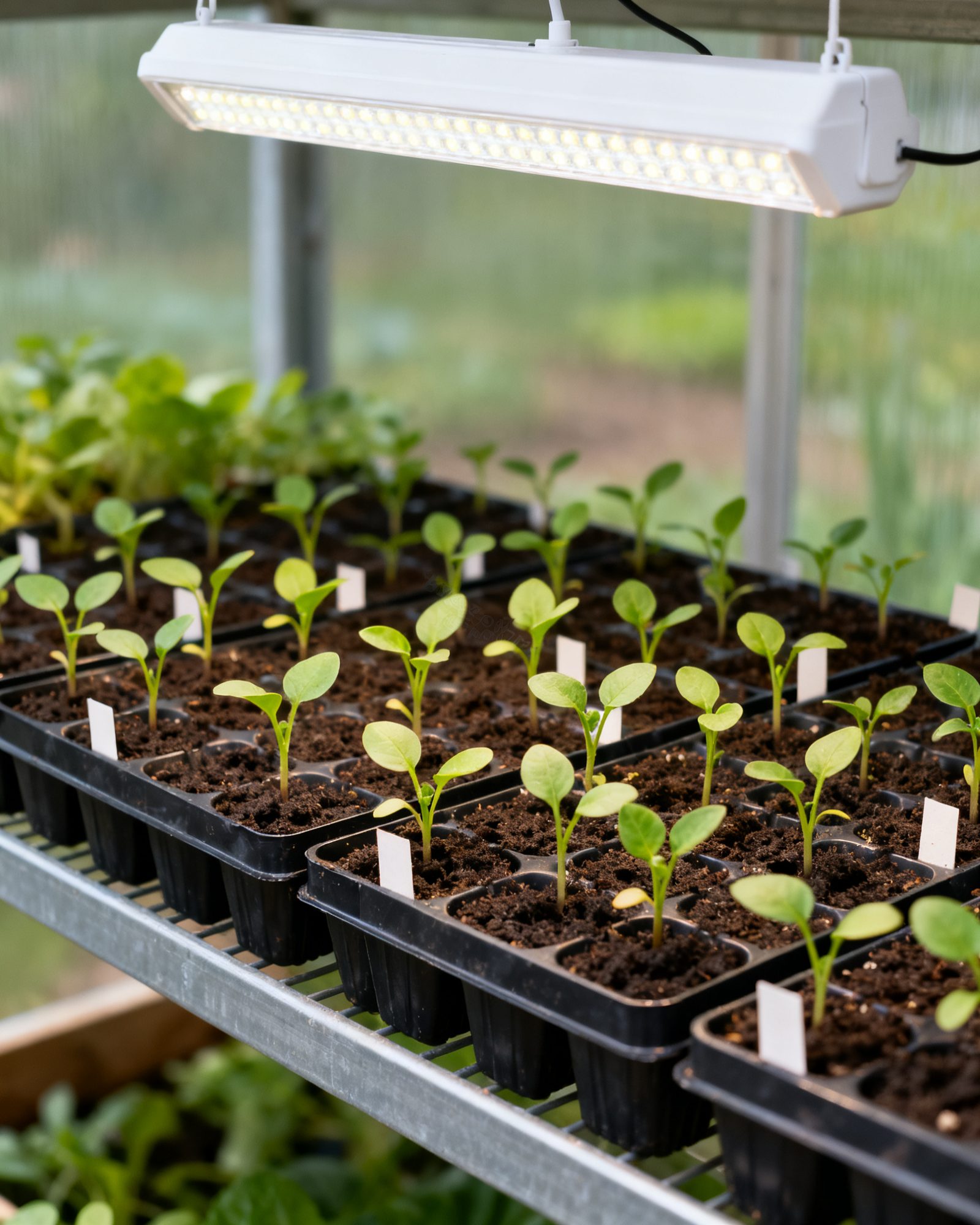
Potting up is the step where a seedling that has outgrown its first cell or flat gets its own larger container. The right moment is shortly after the first true leaves appear for seedlings started together in a flat, or 2 to 3 weeks after germination for tomato, pepper and eggplant started one per cell (Maryland Extension). Move too early and the roots are too fragile to handle; move too late and the plants crowd, stretch and stall. The job itself takes a few minutes per plant and is mostly about handling the seedling gently and setting it at the right depth in fresh mix.
Seed leaves, true leaves, and the signal to pot up
The first pair of leaves a seedling opens are cotyledons, or seed leaves. They come from the seed itself and look the same across many plants in a family. The leaves that follow are true leaves, with the shape the plant will carry in the garden. Those true leaves are the signal that the seedling has roots enough to move.
For plants sown several to a flat, Maryland Extension puts the move shortly after the first true leaves appear. For tomato, pepper and eggplant started one seed per cell, the move comes 2 to 3 weeks after germination. Either way, the plant should be sturdy, not tall and pale, and the mix should be moist but not dripping.
What a seedling ready for potting up looks like
- At least one set of true leaves, with a second set starting.
- A stem that stands on its own rather than leaning toward the light.
- Roots that hold the mix together when the cell is tipped out, but have not begun circling the bottom.
- No yellowing of the lower leaves and no algae or fuzzy growth on the mix surface.
Containers and mix for the next size up
A seedling moving out of a flat needs a container with drainage and enough room for the root mass to spread for a few weeks. Maryland Extension gives suggested cell or pot sizes by crop: 3 to 6 square inches for lettuce, beets, spinach, kale and other greens; 4 to 9 square inches for squash, cucumber, broccoli and cabbage; and 9 to 16 square inches for tomato, eggplant and pepper. Almost any clean container that drains and is at least 2 inches deep can work.
Use a soilless seed-starting or potting mix, not garden soil, bagged topsoil or a garden mix. Garden soil is too dense in a container, at about 75 pounds per cubic foot, and may carry weed seeds and pathogens; a good soilless medium weighs about 10 pounds per cubic foot (Maryland Extension). Moisten dry mix before filling, since peat repels water when dry, and aim for the feel of a wrung-out sponge. Fill the new container to within one inch of the top. The details of mix ingredients and container choices are covered in seed starting mix and containers.
How to lift and separate seedlings without damage
- Water the seedlings several hours before potting up so the mix holds together around the roots.
- Fill the new containers with moistened mix and firm it lightly, leaving room at the top for the seedling.
- Tip the cell or flat and ease the root ball out. If seedlings share a flat, loosen the mix around them with a small tool or a label rather than pulling.
- Hold each seedling by a leaf or by the cotyledons, never by the stem. A crushed stem does not recover.
- Set the seedling in the new container at the same depth it grew, or slightly deeper for tomato, and firm the mix around the roots.
- Water gently until it drains, then let the surface dry slightly before watering again.
When seedlings are sown several to a cell, thinning is the alternative to potting up every one. Snip the weakest at the soil line with small scissors and leave the strongest. Pulling the extra seedling disturbs the roots of the one you are keeping. Maryland Extension notes that sowing two or three seeds per cell and keeping the strongest works for cucumber, squash, melons, corn and beans grown for 2 to 4 weeks without potting up.
Setting the seedling deeper
Tomato seedlings can be set deeper than they grew, and the buried stem will root. Maryland Extension notes that brushing the tops of tomato seedlings by hand makes them stockier, and that tomatoes sown 5 to 6 weeks before planting out make stocky 8- to 10-inch plants. The ideal transplant is about as wide as it is tall. Other crops go in at the depth they grew.
Light and water after potting up
A moved seedling needs the same bright light as before, with the fixture close. Maryland Extension keeps fluorescent or LED fixtures 2 to 6 inches above the plants, on for 14 to 16 hours a day with an outlet timer. After potting up, keep the tops of plants 1 to 2 inches from the lights. Clemson Extension gives 16 to 18 hours of bright light and keeps tubes 2 to 4 inches above the seedlings, raising them as plants grow. Broad-spectrum LED grow lights and cool-white fluorescent tubes both work.
Water when the top of the mix is nearly dry. Water from the top until it drains, or from below by setting containers in a shallow tray. Clemson Extension suggests filling a tray with 1 to 2 inches of water and letting the cells absorb it for 3 to 10 minutes. Saturated mix starves roots of oxygen, so do not leave containers standing in water.
Most potting mixes carry enough fertilizer to grow a seedling for at least 6 weeks, and some labels say 6 to 8 weeks after germination (Maryland Extension). Clemson’s practice is to feed at every other watering once the first true leaves appear, with plain water between feedings. Rinse liquid fertilizer off the leaves, because young seedlings are easily burned.
What goes wrong when potting up seedlings
Waiting too long. Seedlings left crowded in the flat become tall, weak and root-bound, and they do poorly in the garden. Maryland Extension names sowing too early and leaving seedlings crowded as common mistakes. Pot up on time, not after the roots have filled the cell.
Handling by the stem. A seedling held by the stem can be pinched or crushed, and the damage does not heal. Lift by a leaf or a cotyledon; a torn leaf is a small loss, a crushed stem is not.
Pulling instead of snipping. When thinning a cell, pull the extra seedling and you disturb the roots of the one you mean to keep. Snip at the soil line.
Potting up into cold, wet mix. Damping-off is caused by water molds that need free water, and seedlings under lights die of it when the mix is poorly drained or kept too wet. Use a soilless mix, clean containers, and let the top of the mix dry slightly between waterings. Infected seedlings cannot be saved: remove and discard them with their mix, wash the containers, soak them for 1 to 2 minutes in 1 part chlorine bleach to 10 parts water, and rinse.
Stretching after the move. Leggy seedlings come from too little light, fixtures too far away, or a windowsill, and are made worse by warmth and crowding. Tomato and cabbage-family seedlings stretch readily. Keep the light close and raise it as the plants grow.
Fungus gnats. Tiny dark flies around pots are mainly a sign of overwatering. Let the mix dry between waterings and use yellow sticky traps to monitor. Products based on Bacillus thuringiensis var. israelensis are labeled for the larvae; read and follow the label.
Potting up as part of the indoor schedule
The time a crop spends indoors before it goes outside varies. Maryland Extension gives leafy greens 2 to 4 weeks; cabbage, broccoli and cauliflower 4 to 6 weeks; cucumber, squash and melons 3 to 5 weeks; tomato 5 to 6 weeks; and pepper, eggplant and onion 8 to 10 weeks. Clemson Extension’s table runs squash, cucumbers and melons 3 to 5 weeks; broccoli, Brussels sprouts, cabbage, cauliflower, collard and kale 5 to 7 weeks; lettuce 5 to 7 weeks; tomato and eggplant 6 to 8 weeks; and pepper 8 to 10 weeks. Some pepper types need 12 weeks from seed (Maryland Extension).
| Crop group | Maryland Extension | Clemson Extension |
|---|---|---|
| Leafy greens | 2 to 4 weeks | lettuce 5 to 7 weeks |
| Cabbage, broccoli, cauliflower | 4 to 6 weeks | 5 to 7 weeks |
| Cucumber, squash, melons | 3 to 5 weeks | 3 to 5 weeks |
| Tomato | 5 to 6 weeks | 6 to 8 weeks |
| Pepper, eggplant | 8 to 10 weeks | pepper 8 to 10 weeks; eggplant 6 to 8 weeks |
Potting up fits inside that window. A tomato started 5 to 6 weeks before planting out may be moved up once and be ready on time. A pepper that needs 8 to 10 weeks or more may need a second move into a larger container to avoid stalling. The full sequence from sowing to garden is set out in how to start seeds indoors.
Tomato seedlings get their own treatment because they tolerate deeper planting and benefit from early brushing; the details are in growing tomato seedlings.
When potting up is not the right move
Beans, corn and carrots do not do well as transplants and should be sown directly in the garden (Clemson Extension). Asparagus, horseradish, rhubarb, potato, garlic and sweet potato are started from plant parts such as crowns, tubers, cloves and slips, not from seed indoors. For crops that resent root disturbance, such as cucumber, Maryland Extension advises disturbing the roots as little as possible, which is why cucumber, squash and melons are usually sown two or three to a cell, thinned, and set out without potting up.
After potting up, the plants continue under lights until they are ready for the gradual move outdoors. Hardening off and transplanting are separate steps, done on the schedule the crop requires.
Common questions
How do I know when to transplant seedlings to bigger pots?
For seedlings started together in a flat, move them shortly after the first true leaves appear. For tomato, pepper and eggplant started one per cell, move them 2 to 3 weeks after germination. Roots should hold the mix together without circling the bottom of the cell.
What does pricking out seedlings mean?
Pricking out is lifting a small seedling from a crowded flat or cell and moving it into its own container. Water the seedlings first, ease the root ball out, and hold the plant by a leaf or cotyledon, never by the stem.
Should I thin seedlings or pot them all up?
If several seeds sprouted in one cell, snip the weakest at the soil line and keep the strongest. Pulling the extra seedling disturbs the roots of the one you are keeping. Pot up the keeper when it has true leaves and the cell is crowded.
Can I bury the stem when potting up?
Tomato seedlings can be set deeper than they grew, and the buried stem roots. Other crops go in at the depth they grew. Brushing tomato tops by hand also makes them stockier.
Why are my seedlings leggy after potting up?
Too little light is the usual cause, from fixtures too far away or a windowsill. After potting up, Maryland Extension keeps the tops of the plants 1 to 2 inches from the lights; raise the fixture as the plants grow. Warmth and crowding make stretching worse.
Read next
Grow Lights for Seedlings: Distance, Hours and Setup
How far to hang grow lights above seedlings, how many hours a day they need, LED versus fluorescent, and the setup mistakes that leave plants leggy and weak.
Seed Germination Temperature, Domes and Heat Mats
Most vegetable seeds germinate best at 65° to 75°F. How to use domes and heat mats, when to remove the cover, and how to cool seedlings after sprouting.
How to Start Seeds Indoors, Step by Step
A practical, step-by-step guide to starting vegetable and herb seeds indoors: timing, containers, mix, warmth, light, watering, potting up and hardening off.