Grow Lights for Seedlings: Distance, Hours and Setup
How far to hang grow lights above seedlings, how many hours a day they need, LED versus fluorescent, and the setup mistakes that leave plants leggy and weak.
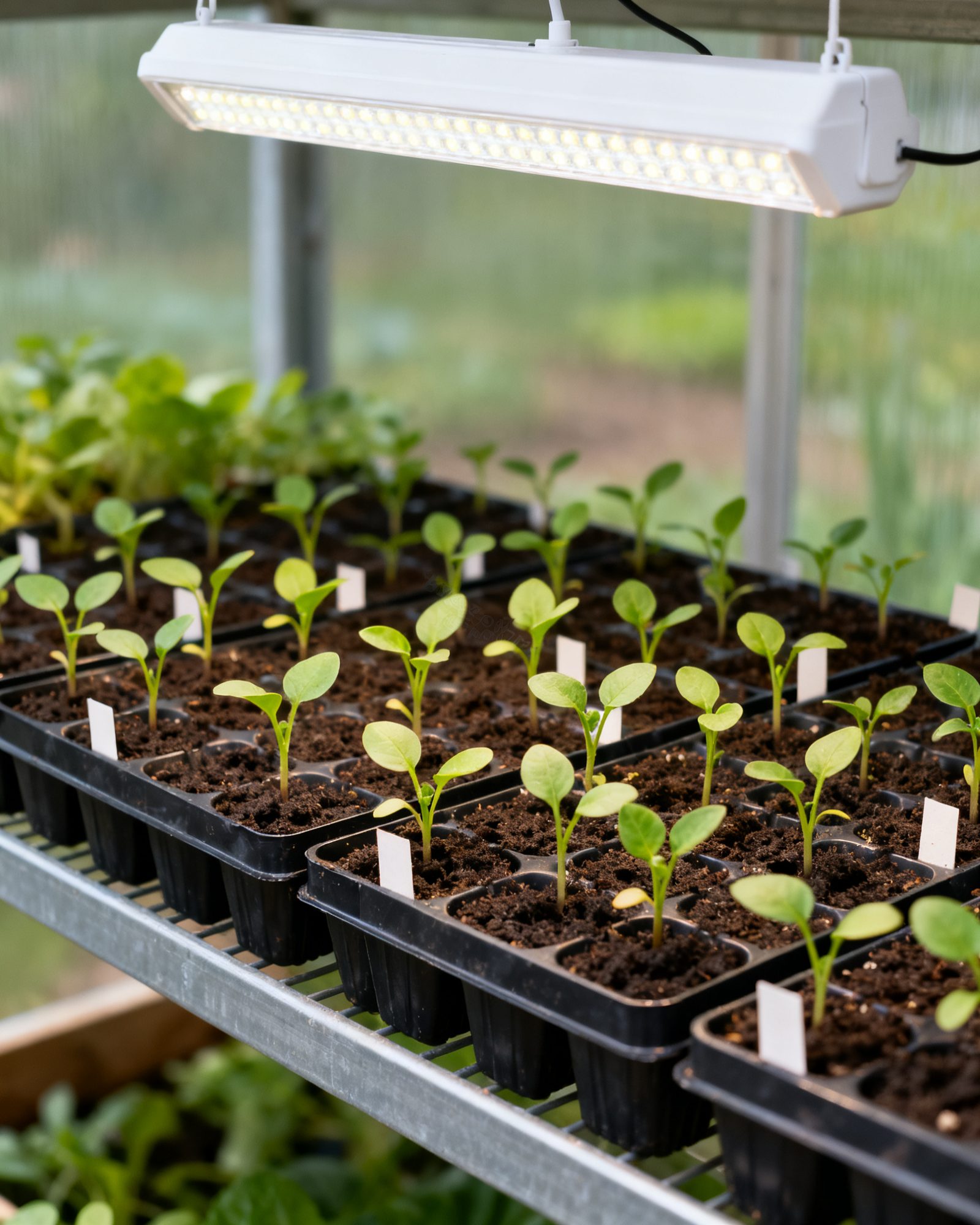
A window is seldom enough light to grow a stocky vegetable transplant. Maryland Extension notes that on a windowsill stems stretch and lean. A dedicated fixture hung close above the plants, on a timer, is what produces the short, thick-stemmed seedlings that transplant well. The two numbers that matter most are distance and hours: keep the light close to the tops of the plants, and run it long enough each day to stand in for the sun.
Why the windowsill falls short
Light through glass is weaker than light outdoors, and it comes from one direction. A seedling that has to reach for light grows a longer stem and smaller leaves. Turn the tray and the plant leans the other way; leave it and one side stays weak. Maryland Extension notes that a window is seldom enough for vegetable seedlings, and both extension sources give their light guidance for fixtures hung close above the plants.
A fixture also lets you control the day length. On a windowsill the days are still short in late winter, when most seeds are started, and a cloudy week sets seedlings back. Under a light on a timer, every day is the same.
LED or fluorescent: either works
Maryland Extension lists both broad-spectrum LED grow lights and cool-white fluorescent tubes (6500K) as workable choices for seed starting. The difference is in how they are hung and how much heat they throw, not in whether seedlings will grow.
| Fixture type | Light quality | Heat at the canopy | Hanging notes |
|---|---|---|---|
| Cool-white fluorescent tubes (6500K) | Bright, cool-white; good for seedlings | Low; tubes can sit close | Keep tubes close and raise them as plants grow |
| Broad-spectrum LED | Full-spectrum; efficient | Low to moderate depending on fixture | Follow the same close-hanging rule; check the canopy by hand for heat |
Either way, the fixture needs to be adjustable. Hanging chains or a shelf that moves up are more useful than a fixed bracket, because the correct height changes as the seedlings grow.
How far above the seedlings
The light should hang close enough to keep the plants stocky but far enough not to scorch them. The two extension sources give slightly different ranges, and both are workable.
| Source | Distance above plants | Hours per day |
|---|---|---|
| Maryland Extension | 2 to 6 inches | 14 to 16 hours |
| Clemson Extension | 2 to 4 inches | 16 to 18 hours |
| Maryland Extension, after potting up | 1 to 2 inches from the tops | (same schedule) |
Start at the closer end of the range for fluorescent tubes, which run cool, and check the back of your hand at canopy height: if it feels hot, raise the fixture. As the seedlings grow, raise the light so the distance stays the same. A fixture left at one height while the plants grow toward it ends up touching the leaves.
After seedlings are potted into individual containers, Maryland Extension suggests keeping the tops of the plants 1 to 2 inches from the lights. That close spacing is what keeps growth compact.
How many hours a day
Maryland Extension gives 14 to 16 hours a day; Clemson gives 16 to 18 hours of bright light. Either schedule is a long day by indoor standards, and it is meant to be consistent. A simple outlet timer set once does the job and removes the daily decision. Without a timer, seedlings get long days some weeks and short days others, and the short weeks show up as stretched stems.
Do not run the lights around the clock. Seedlings need a dark period, and continuous light does not make up for a fixture that is too far away.
Setting up the light and the air
- Set the fixture so the tubes or panel sit a few inches above the top of the containers, then adjust as the seedlings grow.
- Put the light on an outlet timer set for the day length you have chosen.
- Start a small fan near the seedlings once they have two true leaves. Clemson Extension notes that the moving air makes the stems sway and begins toughening them; it also dries the mix faster, so watch moisture more closely.
- Keep the light close and the room cool at night. Maryland Extension gives 55 to 60°F at night and 65 to 70°F by day for seedlings after germination. Warmth plus weak light is what produces tall, thin stems.
- Water when the top of the mix is nearly dry, and do not let the containers sit in water.
A plastic tent over a light can hold 70° to 75°F, which is useful before germination but should come off once sprouts appear. For the germination stage itself, including domes and heat mats, see seed germination temperature, domes and heat mats.
Getting the seedlings started under the light
Fill clean containers that drain and are at least 2 inches deep with a soilless seed-starting mix, moistened to the feel of a wrung-out sponge. Sow at a depth of about twice the seed’s diameter (lettuce and celery uncovered or barely covered), and keep the mix warm until sprouts show. Then move the containers under the fixture and bring the light down close.
The full sequence, from filling flats to potting up, is in how to start seeds indoors, step by step. The light matters from the moment the seedlings break the surface: the first days after emergence are when a weak light source does the most damage.
What goes wrong under lights
The light hangs too high
This is the most common cause of leggy seedlings. A fixture hung well above the recommended range gives light too weak to hold the stems short, and the seedlings stretch toward it. Tomato and cabbage-family seedlings stretch readily. Lower the fixture to the distance in the table and raise it as the plants grow.
The hours are too few, or irregular
A light run for a few hours in the evening, or switched on when someone remembers, gives an inconsistent day. Set a timer for 14 to 16 hours and leave it. If the seedlings are already tall and thin, the fixes are in leggy seedlings: causes and fixes.
The seedlings are too warm
Warmth speeds growth, and without strong light that growth is tall and weak. Keep the room on the cool side after germination and keep the light close.
The fixture is too close and hot
Some LED panels and other fixtures run warmer at the canopy than fluorescent tubes. Check with the back of your hand at canopy height. If it feels hot, raise the light a little; scorched leaves will not recover.
The mix stays wet
A fan and a close light both dry the surface faster, but overwatering still causes trouble. Saturated mix starves roots of oxygen and invites damping-off, a water-mold disease that collapses seedlings at the soil line. Let the top of the mix dry slightly between waterings, use a soilless mix, and discard any seedling that collapses rather than trying to save it.
Seedlings are crowded under the light
Leaving seedlings crowded in the flat too long is one of the most common mistakes. Pot them into their own containers shortly after the first true leaves appear, or 2 to 3 weeks after germination for tomato, pepper and eggplant started one per cell. Hold seedlings by a leaf, never by the stem.
When the light has done its job
A stocky transplant is the goal: Maryland Extension describes a tomato started 5 to 6 weeks before planting out as an 8- to 10-inch plant about as wide as it is tall. Once seedlings reach that stage, the next step is adapting them to outdoor sun and wind, which is a separate job from the light schedule. Until then, keep the fixture close, keep the timer set, and raise the light as the plants grow.
Common questions
How far should grow lights be from seedlings?
Maryland Extension suggests 2 to 6 inches above the plants, and Clemson Extension suggests 2 to 4 inches. After potting up, Maryland suggests keeping the tops of the plants 1 to 2 inches from the lights. Check with the back of your hand at canopy height; if it feels hot, raise the fixture.
How many hours of light do seedlings need each day?
Maryland Extension gives 14 to 16 hours a day, and Clemson Extension gives 16 to 18 hours of bright light. Use an outlet timer so the day length stays consistent. Do not run the lights continuously; seedlings need a dark period.
Are LED or fluorescent lights better for seedlings?
Either works. Maryland Extension lists broad-spectrum LED grow lights and cool-white fluorescent tubes (6500K) as suitable for seed starting. Fluorescent tubes run cool and can sit close; LED fixtures vary in heat output, so check the canopy by hand and adjust the height.
Can seedlings grow in a window instead of under lights?
A window is seldom enough. Maryland Extension notes that seedlings on a windowsill stretch and lean. A fixture hung close above the plants, on a timer, gives stronger, more even light and a consistent day length.
Why are my seedlings tall and thin under a grow light?
Too little light is the usual cause: the fixture is too far away, the hours are too few, or both. Warmth and crowding make it worse. Lower the light to the recommended distance, set a timer for 14 to 16 hours, and keep the room cooler at night.
Read next
Seed Germination Temperature, Domes and Heat Mats
Most vegetable seeds germinate best at 65° to 75°F. How to use domes and heat mats, when to remove the cover, and how to cool seedlings after sprouting.
How to Start Seeds Indoors, Step by Step
A practical, step-by-step guide to starting vegetable and herb seeds indoors: timing, containers, mix, warmth, light, watering, potting up and hardening off.
Potting Up Seedlings: When and How to Move Them
Learn when to pot up seedlings, how to separate and lift them without damage, what container size to use, and how to avoid mistakes that set plants back.