Leggy Seedlings: Why They Stretch and How to Fix It
Leggy seedlings are tall, thin and weak. Learn the causes—low light, warmth, crowding—and the fixes that make stocky transplants before planting out.
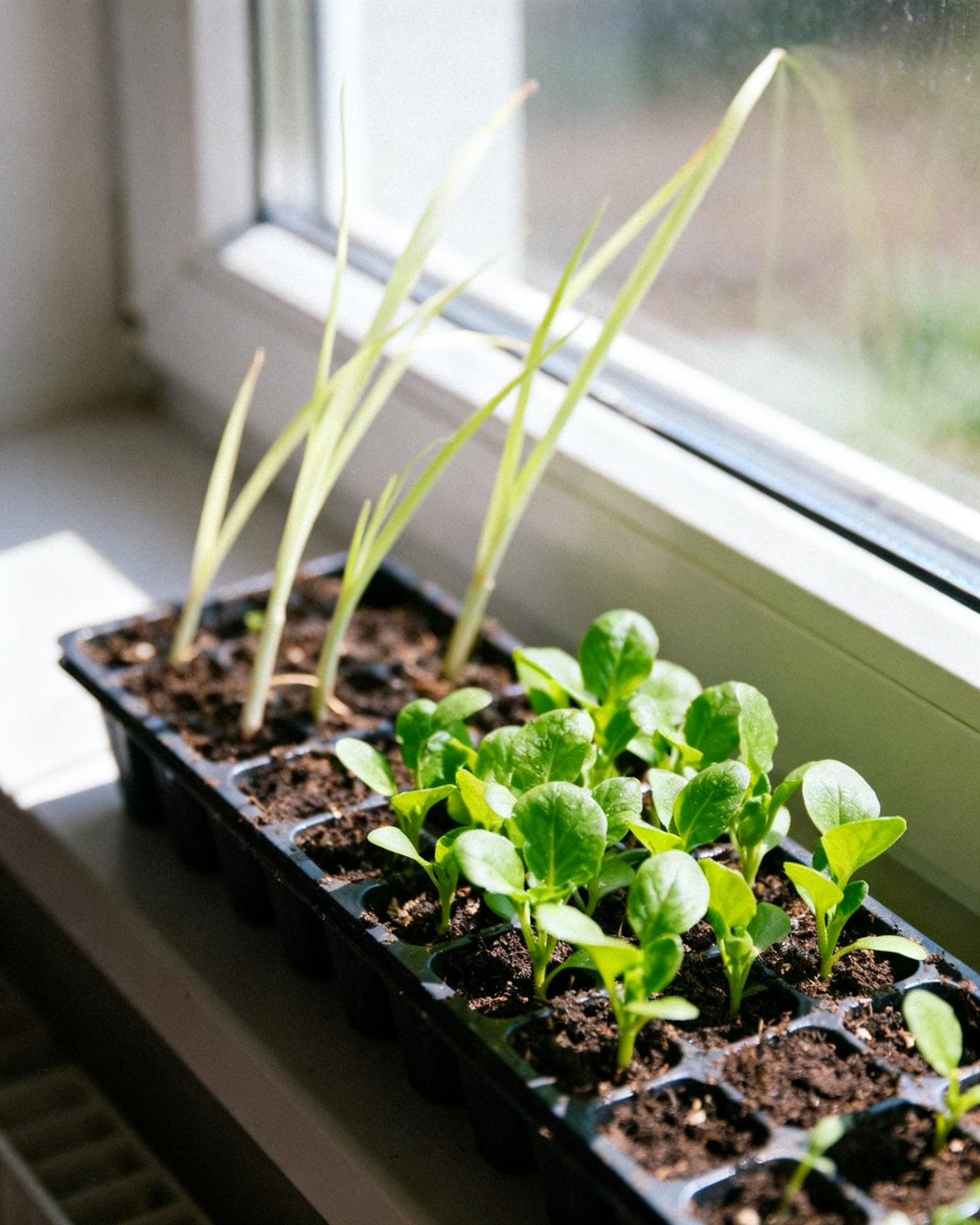
A leggy seedling is one that has grown tall and thin instead of short and stocky. The stem stretches between leaves, the plant leans toward the light, and it looks weak enough to snap. The cause is usually too little light, and often warmth and crowding on top of it. The fix is to move the light closer, keep it on longer, cool the plants down and give each one room. Many stretched seedlings can be salvaged if you act before they fall over.
How to tell a leggy seedling from a healthy one
A healthy vegetable transplant is about as wide as it is tall, with deep green leaves and a sturdy stem. A leggy seedling has a long, pale gap between the seed leaves and the first true leaves, and the stem may be so thin it bends under its own weight. Tomato and cabbage-family seedlings stretch readily, so they show the problem first. If the stem is still firm and the leaves are green, the plant is stretched but recoverable. If the stem has collapsed at the soil line, that is a different problem—damping-off—and those seedlings cannot be saved.
What makes seedlings stretch
Light that is too weak or too far away
A windowsill is seldom enough. Even a bright window gives far less light than a seedling needs, and the plant responds by growing toward the glass, so stems stretch and lean. The same happens under a grow light hung too high: the seedling reaches for the light and puts its energy into stem length rather than leaf and root growth.
Warmth without enough light
Warmth speeds growth, but if light is short, the new growth is thin and soft. A warm room with a weak light is the classic recipe for stretched seedlings.
Crowding
Seedlings sown thickly in a flat compete for light and each one stretches to get above its neighbors. Leaving them crowded too long is one of the most common mistakes in indoor seed starting.
Sowing too early
Starting seed earlier than the crop needs gives plants that must be held indoors for weeks longer than planned. They become tall and root-bound and do poorly in the garden. Maryland Extension lists sowing too early as a common mistake.
Fixes you can apply this week
Lower the light and keep it on longer
Maryland Extension suggests keeping fluorescent or LED fixtures 2 to 6 inches above the plants, on for 14 to 16 hours a day with an outlet timer. Clemson Extension gives 16 to 18 hours of bright light and keeps tubes 2 to 4 inches above the seedlings, raising them as the plants grow. After potting up, keep the tops of plants 1 to 2 inches from the lights. Broad-spectrum LED grow lights and cool-white fluorescent tubes (6500K) both work. For the details of hanging height and timing, see grow lights for seedlings: distance, hours and setup.
Cool the plants down after germination
Once seedlings are up, Maryland Extension gives a night temperature of 55 to 60°F and a day temperature of 65 to 70°F. Cooler conditions slow stem elongation while the leaves keep developing.
Give each seedling room
Move plants started together in a flat into their own containers shortly after the first true leaves appear. Tomato, pepper and eggplant started one per cell are moved up 2 to 3 weeks after germination. Hold seedlings by a leaf or the cotyledons, never by the stem. Suggested cell or pot sizes from Maryland Extension:
| Crop | Suggested cell or pot size |
|---|---|
| Lettuce, beets, spinach, kale and other greens | 3 to 6 square inches |
| Squash, cucumber, broccoli and cabbage | 4 to 9 square inches |
| Tomato, eggplant and pepper | 9 to 16 square inches |
Use a small fan
From the two-true-leaf stage, a small fan near the seedlings makes them sway and begins toughening them. It also dries the mix faster, so watch moisture. Brushing tomato tops by hand has a similar effect and makes them stockier.
Bury the stem when you pot up or plant out
Tomato seedlings can be set deeper than they grew, and the buried stem roots. A tall tomato transplant can be planted in a trench with only 2 or 3 sets of leaves above ground. Sown 5 to 6 weeks before planting out, tomatoes make stocky 8- to 10-inch plants. For the full sequence from seed to garden, see growing tomato seedlings from seed to garden.
Which leggy seedlings can be saved
Stretched seedlings with firm stems and green leaves can usually be saved by lowering the light, cooling the plants and potting them up. Tomatoes are the most forgiving because they can go in deeper and root along the buried stem. Peppers and eggplants recover more slowly; give them bright light and time. Seedlings that have collapsed at the soil line from damping-off cannot be saved: remove and discard them with their mix, wash the containers, soak them for 1 to 2 minutes in 1 part chlorine bleach to 10 parts water, and rinse. If you are not sure what is wrong, the seedling problems diagnosis guide walks through the common symptoms.
What goes wrong: mistakes to avoid
- Relying on a window. A window is seldom enough; stems stretch and lean. Use a fixture close to the plants instead.
- Raising the light too far. Hanging a fixture high to cover more plants gives weak light and stretched stems. Keep it close and raise it as the plants grow.
- Leaving seedlings crowded. Crowding makes them compete for light and stretch. Pot up on time.
- Sowing too early. Plants held indoors too long become tall and root-bound. Match sowing date to the crop’s indoor time.
- Keeping the mix too wet. Saturated media starve roots of oxygen and encourage damping-off and fungus gnats. Let the top of the mix dry slightly between waterings.
- Hardening off too severely. Cucumbers and melons stop growing if hardened too severely. Follow a gradual schedule and bring cool-season crops in if a freeze is forecast.
Preventing stretch from the start
Set the light close before the seeds even germinate, and remove any clear cover as soon as sprouts appear. Keep the room cool after germination. Sow at the right time for your crop—Maryland Extension gives leafy greens 2 to 4 weeks indoors, cabbage, broccoli and cauliflower 4 to 6 weeks, cucumber, squash and melons 3 to 5 weeks, tomato 5 to 6 weeks, and pepper, eggplant and onion 8 to 10 weeks. Clemson Extension’s table runs longer for tomato and eggplant, at 6 to 8 weeks, and gives pepper the same 8 to 10 weeks. Where the two differ, follow the seed packet and your own frost date. A small fan and timely potting up finish the job.
Common questions
Why are my seedlings tall and thin?
The usual cause is too little light or a light hung too far away. Warmth and crowding make it worse. Move the fixture closer, run it longer and cool the plants after germination.
How do I fix leggy seedlings?
Lower the light to 2 to 6 inches above the plants, keep it on 14 to 16 hours a day, cool nights to 55 to 60°F and pot up crowded seedlings. A small fan from the two-true-leaf stage helps toughen stems.
Can stretched seedlings recover?
Yes, if the stem is still firm and the leaves are green. Give them more light, cooler nights and their own containers. Tomatoes are the most forgiving because they can be potted up or planted deeper and the buried stem roots.
Should I bury leggy tomato seedlings deeper?
Yes. Tomato seedlings can be set deeper than they grew, and a tall transplant can go in a trench with only 2 or 3 sets of leaves above ground. The buried stem roots.
How close should grow lights be to seedlings?
Maryland Extension suggests 2 to 6 inches above the plants, on 14 to 16 hours a day. Clemson Extension keeps tubes 2 to 4 inches above the seedlings and raises them as plants grow.
Read next
Damping-Off: Why Seedlings Collapse and How to Prevent It
Damping-off is a water-mold disease that kills seeds before they emerge and topples seedlings at the soil line. Learn the signs, the causes, and how to prevent it.
Fungus Gnats and Other Pests on Indoor Seedlings
Tiny black flies over seedling trays mean the mix is too wet. Learn to dry it out, trap the adults, and check seedlings and transplants for other pests.
Seedling Problems: A Diagnosis Guide
A symptom-to-cause guide to seedling problems: no sprouts, damping-off, leggy growth, yellow leaves, fungus gnats, and stalled transplants, with fixes.