How to Start Seeds Indoors, Step by Step
A practical, step-by-step guide to starting vegetable and herb seeds indoors: timing, containers, mix, warmth, light, watering, potting up and hardening off.
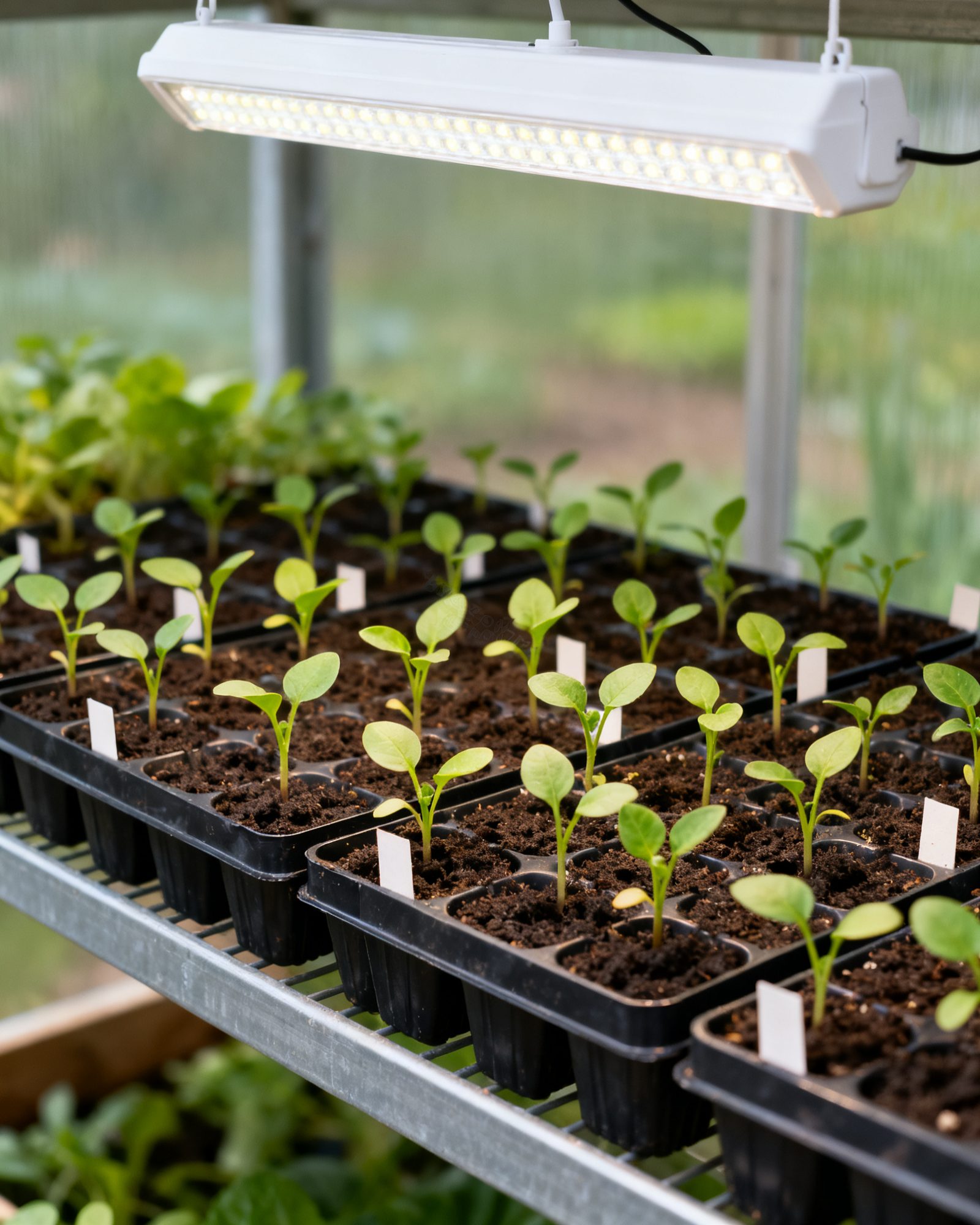
Starting seeds indoors is a sequence of small, ordinary steps done in the right order: pick the crops that benefit, count back from your last frost date, sow in a clean container of soilless mix at a depth of about twice the seed’s diameter, keep the mix warm and moist until sprouts show, then give the seedlings strong light, steady air and careful watering until they are ready to harden off and go outside. Most failures come from starting too early, keeping plants on a windowsill, or watering too often, not from anything exotic.
Which crops are worth starting indoors
Not every vegetable needs a head start. Beans, corn and carrots do not do well as transplants and should be sown directly in the garden, according to Clemson Cooperative Extension. Cucumber, squash, melons, corn and beans can be grown for 2 to 4 weeks as transplants without potting up: sow two or three seeds per cell and keep the strongest (Maryland Extension).
Asparagus, horseradish, rhubarb, potato, garlic and sweet potato are started from plant parts (crowns, tubers, cloves, slips), not from seed indoors.
The crops that repay indoor sowing are the ones that need a long season or a careful start: tomato, pepper, eggplant, onion, cabbage, broccoli, cauliflower, lettuce and other leafy greens. The table below shows the approximate time indoors before planting out, as given by Maryland Extension and Clemson Extension. Where the two differ, both are shown.
| Crop group | Maryland Extension | Clemson Extension |
|---|---|---|
| Leafy greens | 2 to 4 weeks | lettuce 5 to 7 weeks |
| Cabbage, broccoli, cauliflower | 4 to 6 weeks | 5 to 7 weeks (also Brussels sprouts, collard, kale) |
| Cucumber, squash, melons | 3 to 5 weeks | 3 to 5 weeks |
| Tomato | 5 to 6 weeks | 6 to 8 weeks |
| Eggplant | 8 to 10 weeks | 6 to 8 weeks |
| Pepper, onion | 8 to 10 weeks | pepper 8 to 10 weeks |
Maryland Extension notes that some pepper types need 12 weeks from seed, and recommends starting pepper seed indoors 8 to 10 weeks before the average frost-free date. Squash can be ready to transplant about three weeks after sowing; a pepper may take eight weeks or more.
Count back from your last frost date
The last frost date is the anchor for every sowing date. Seed packets and extension tables give a number of weeks before the average frost-free date; count backward from your local date, not from a date on a national map. Frost dates are past averages, not forecasts, and they differ from one town to the next, so ask the local Cooperative Extension office for local dates and check the forecast before setting tender plants out.
A common mistake is sowing too early, which gives tall, root-bound plants that do poorly in the garden (Maryland Extension). Later sowing into warmer, brighter conditions usually produces a better transplant than an early sowing stretched on a windowsill. The full method for counting back is set out in when to start seeds indoors.
Containers and mix
Almost any clean container that drains and is at least 2 inches deep works. A standard plastic flat is 10 inches by 20 inches, and depending on cell size, 10 to 120 plants fit in one flat (Maryland Extension). Suggested cell or pot size per plant, also from Maryland Extension:
- Lettuce, beets, spinach, kale and other greens: 3 to 6 square inches
- Squash, cucumber, broccoli and cabbage: 4 to 9 square inches
- Tomato, eggplant and pepper: 9 to 16 square inches
Use a soilless seed-starting or potting mix, not garden soil, bagged topsoil or garden mixes. Garden soil is too dense in a container (about 75 pounds per cubic foot) and may carry weed seeds and pathogens; good soilless media weigh about 10 pounds per cubic foot. Moisten dry mix before filling, because peat repels water when dry; it should be as moist as a wrung-out sponge. Fill containers to within one inch of the top (Maryland Extension). Soilless mixes also reduce soil-borne disease such as damping-off (Clemson Extension). More on choosing and filling containers is in seed starting mix and containers.
Sowing depth and spacing
Sow about twice the seed’s diameter: a seed 1/8 inch wide goes about 1/4 inch deep (Maryland Extension). The Maryland germination page gives the rule as 2-3 times the seed’s diameter. Shallow rows in a flat are 1/8 to 1/4 inch deep and 1 to 2 inches apart. Lettuce and celery seed germinate best in light and are left uncovered or barely covered.
Label each container with the crop and the date. Seedlings of different crops look much alike at the cotyledon stage, and the sowing date tells you when to expect germination and when to pot up.
Warmth for germination
A potting-mix temperature of 65° to 75°F suits most vegetable seeds (Maryland Extension). A clear cover or dome keeps moisture in until sprouts appear and comes off as soon as they do. A seedling heat mat speeds germination; a plastic tent over a grow light can hold 70º to 75º F, and the top of a refrigerator is a warm spot. After germination, seedlings do well with a 55 to 60°F night temperature and a 65 to 70°F day temperature.
Most warm-season vegetable seeds (beans, squash, cucumbers) will not germinate in soil below 50°F; lettuce, pea, radish, carrot, beet and spinach germinate in soil above 40°F; soil over 85°F is usually a problem only for spinach and lettuce seed. Lima bean, parsley, watermelon and okra germinate slowly (10-21 days) at typical spring soil temperatures.
Light: the step most first tries get wrong
A window is seldom enough; stems stretch and lean. Keep fluorescent or LED fixtures 2 to 6 inches above the plants, on for 14 to 16 hours a day with an outlet timer (Maryland Extension). Clemson Extension gives 16-18 hours of bright light and keeps tubes 2 to 4 inches above the seedlings, raising them as plants grow. After potting up, keep the tops of plants 1 to 2 inches from the lights (Maryland Extension). Broad-spectrum LED grow lights and cool-white fluorescent tubes (6500K) both work (Maryland Extension).
A small fan near seedlings from the two-true-leaf stage makes them sway and begins toughening them; it also dries them faster, so watch moisture (Clemson Extension). Fixture height, hours and timer setup are covered in grow lights for seedlings.
Watering and feeding
Wait until the top of the mix is nearly dry; water from the top until it drains, or from below by setting containers in a shallow tray of water. Clemson Extension suggests filling a tray with 1 to 2 inches of water and letting the cells absorb it for 3 to 10 minutes. Saturated media starve roots of oxygen.
Most potting mixes carry enough fertilizer to grow a seedling for at least 6 weeks; some labels say 6 to 8 weeks after germination (Maryland Extension). Clemson Extension’s practice: once the first true leaves appear, feed at every other watering with a water-soluble starter fertilizer, plain water between feedings. Rinse liquid fertilizer off leaves; young seedlings are easily burned (Maryland Extension).
Potting up
Plants started together in a flat are moved to their own containers shortly after the first true leaves appear; tomato, pepper and eggplant started one per cell are moved up 2 to 3 weeks after germination (Maryland Extension). Hold seedlings by a leaf or the cotyledons (“seed leaves”), never by the stem. Leaving seedlings crowded in the flat too long is one of the most common mistakes.
Tomato seedlings can be set deeper than they grew; brushing the tops by hand makes them stockier. Sown 5 to 6 weeks before planting out, tomatoes make stocky 8- to 10-inch plants; the ideal transplant is about as wide as it is tall (Maryland Extension).
Hardening off and planting out
Hardening off gradually adapts indoor-grown plants to sun, wind and cold. Maryland Extension describes a 5- to 14-day period depending on the crop, beginning 1-2 weeks before planting out. Clemson Extension says to start once plants are about three inches tall and continue for two to three weeks. Start in a shaded, wind-protected spot for part of the day; increase sun by an hour or two each day; water less often but never let plants wilt. Do not put tender seedlings out on windy days or below 45°F. Bring cool-season crops (lettuce, cabbage) in if a freeze is forecast and warm-season crops (tomato, pepper) in if the night will drop below 50°F. Cucumbers and melons stop growing if hardened too severely and can stay out overnight only if it will not fall below 50°F. A cold frame is an excellent place to harden off.
Overdoing it harms some crops: cauliflower can form thumb-sized heads and stop. Hardening off matters most for cabbage, broccoli and cauliflower; it matters less for warm-season transplants set out after all danger of frost into soil above 60°F. After proper hardening, tomato plants can usually tolerate a light, unexpected frost with little damage. The day-by-day schedule is in how to harden off seedlings.
On planting day, choose a cloudy, calm day; water plants several hours before; dig a hole large enough for the root mass; firm the soil; water in with a weak liquid fertilizer at label dilution; shade and shelter new transplants for a few days (baskets, pots, floating row cover). Biodegradable pots (peat, coir, manure) can go in the ground, but remove the base and any rim above the soil line, because an exposed rim wicks water away from the roots. Good transplants are stocky with deep green leaves and white, fibrous roots; avoid overgrown, woody plants with a thick mat of circling roots and plants with pests (Maryland Extension).
The stages at a glance
| Stage | What to do |
|---|---|
| Choose crops | Start long-season crops indoors; sow beans, corn and carrots direct |
| Time it | Count back from the local last frost date; avoid sowing too early |
| Fill containers | Clean, draining containers at least 2 inches deep; moist soilless mix to within one inch of the top |
| Sow | About twice the seed’s diameter deep; label with crop and date |
| Germinate | 65° to 75°F mix temperature; cover until sprouts show, then uncover |
| Grow | 2 to 6 inches from lights, 14 to 16 hours a day (Maryland; Clemson: 2 to 4 inches, 16-18 hours); 55 to 60°F nights, 65 to 70°F days |
| Water and feed | Let the surface nearly dry between waterings; the mix’s own fertilizer lasts weeks (Maryland), or feed at every other watering once true leaves appear (Clemson) |
| Pot up | Move crowded seedlings to their own containers after first true leaves |
| Harden off | 5 to 14 days, or two to three weeks per Clemson, before planting out |
| Plant out | Cloudy, calm day; water in; shelter for a few days |
What goes wrong
Sowing too early. Tall, root-bound plants that do poorly in the garden are the usual result (Maryland Extension). Wait for the right count-back date rather than sowing weeks ahead of it.
Window light. A window is seldom enough; stems stretch and lean. Leggy seedlings come from too little light, fixtures too far away or a window, and are made worse by warmth and crowding; tomato and cabbage-family seedlings stretch readily. Tall tomato transplants can be planted in a trench with only 2 or 3 sets of leaves above ground, and the buried stem roots.
Overwatering and damping-off. Damping-off is caused by water molds (Pythium, Phytophthora and Rhizoctonia) that need free water; seedlings under lights die of it when the mix is poorly drained or kept too wet. It can kill seeds before they emerge and collapse young seedlings; Rhizoctonia constricts the lower stem (“wirestem”). Infected seedlings cannot be saved: remove and discard them with their mix, wash containers, soak them for 1 to 2 minutes in 1 part chlorine bleach to 10 parts water, and rinse. Prevention is a soilless mix, clean containers, no overwatering, and letting the top of the mix dry slightly between waterings.
Fungus gnats. Tiny dark flies around pots are mainly a sign of overwatering; their larvae live in constantly moist potting mix rich in organic matter. Let the mix dry, use yellow sticky traps to monitor, and if a product is used, follow the label.
Crowding. Leaving seedlings in the flat too long produces weak, spindly plants. Pot up when the first true leaves appear.
Hardening off too hard. Cucumbers and melons stop growing if hardened too severely, and cauliflower can form thumb-sized heads and stop. Increase exposure gradually and bring plants in when the temperature drops below the crop’s limit.
Common questions
How do I know when to start my seeds indoors?
Count back from the date each crop will go outside, using the weeks given for each crop: for tender crops that is after your local average last frost date, while hardy crops such as broccoli go out earlier. Maryland Extension suggests 5 to 6 weeks for tomato, 8 to 10 weeks for pepper, and 4 to 6 weeks for cabbage, broccoli and cauliflower. Clemson Extension gives somewhat different ranges, such as 6 to 8 weeks for tomato. Ask your Cooperative Extension office for local frost dates.
Why are my seedlings tall and skinny?
Too little light is the usual cause: a windowsill, or fixtures hung too far above the plants. Keep fluorescent or LED lights 2 to 6 inches above the seedlings and run them 14 to 16 hours a day. Warmth and crowding make stretching worse, so move plants to cooler conditions and pot them up on time.
How often should I water seedlings indoors?
Water when the top of the mix is nearly dry, not on a fixed schedule. Water from the top until it drains, or set containers in a shallow tray of water for a few minutes. Constantly wet mix starves roots of oxygen and invites damping-off and fungus gnats.
Do I need a heat mat to start seeds?
Not for every crop, but warmth speeds germination. A potting-mix temperature of 65° to 75°F suits most vegetable seeds. A heat mat, a plastic tent over a grow light, or the top of a refrigerator can provide that warmth. Take the cover off as soon as sprouts appear.
Can I put seedlings outside without hardening them off?
Not without risk. Indoor-grown plants need gradual exposure to sun, wind and cold. Maryland Extension describes a 5- to 14-day period; Clemson Extension suggests two to three weeks starting when plants are about three inches tall. Start in shade and increase sun by an hour or two a day, and bring tender crops in when nights are cold.
Read next
Grow Lights for Seedlings: Distance, Hours and Setup
How far to hang grow lights above seedlings, how many hours a day they need, LED versus fluorescent, and the setup mistakes that leave plants leggy and weak.
Seed Germination Temperature, Domes and Heat Mats
Most vegetable seeds germinate best at 65° to 75°F. How to use domes and heat mats, when to remove the cover, and how to cool seedlings after sprouting.
Potting Up Seedlings: When and How to Move Them
Learn when to pot up seedlings, how to separate and lift them without damage, what container size to use, and how to avoid mistakes that set plants back.