When to Start Seeds Indoors: Count Back from Last Frost
Use your last frost date to time indoor sowing. Tables compare Maryland and Clemson week counts for tomato, pepper, broccoli and more, plus why early sowing fails.
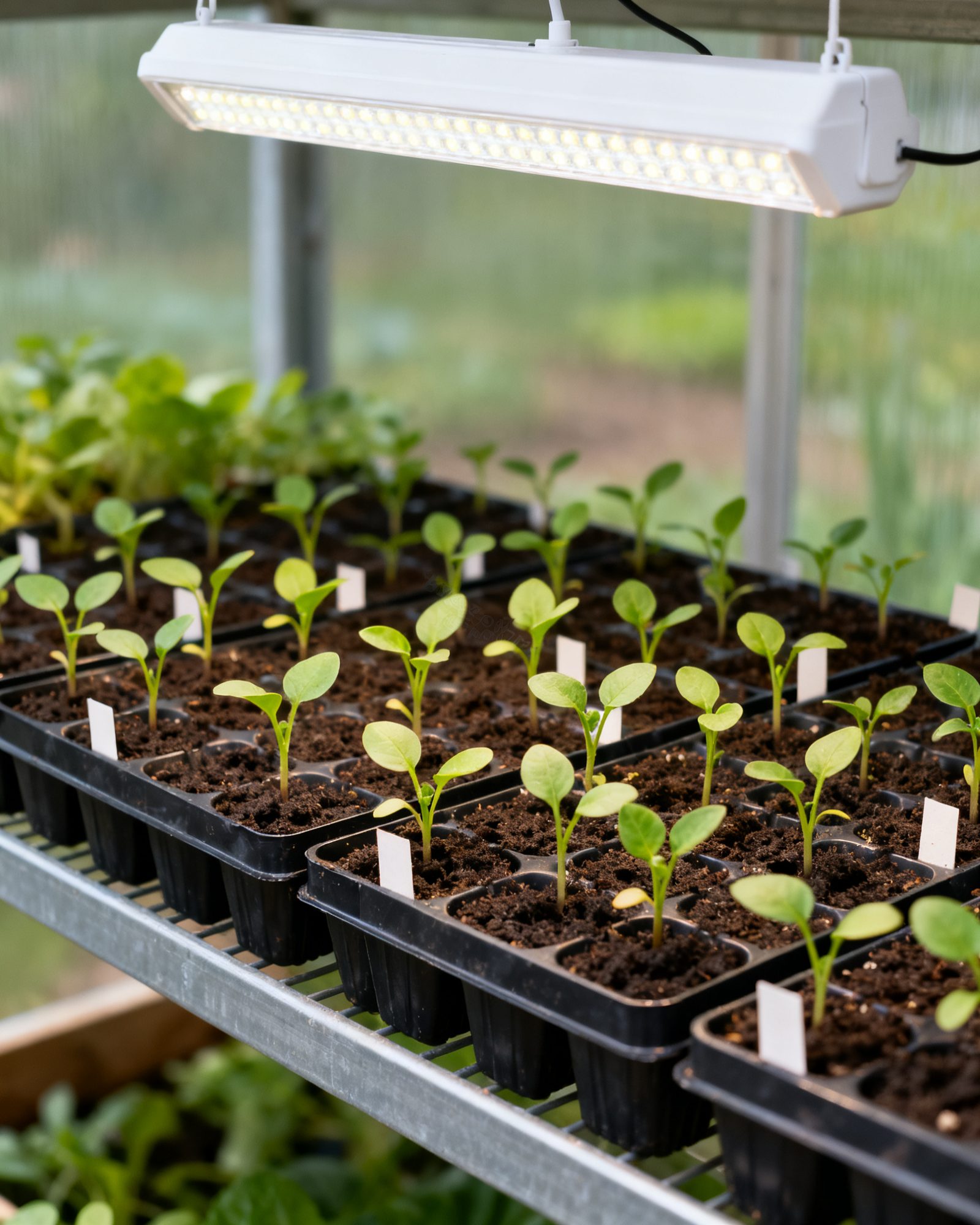
The date you start seeds indoors is set by counting backward from your average last spring frost date. Each crop needs a certain number of weeks to reach transplant size, and that number differs by crop and by the source you consult. Start too late and the transplant is small; start too early and it is tall, root-bound and slow to establish. The work is to find a defensible frost date, look up the weeks for each crop, and put the sowing dates on a calendar.
Find the frost date you will count from
Your average last spring frost date is a local, historical figure, not a forecast. NOAA’s National Centers for Environmental Information publishes probable last-frost dates for weather stations across the country, calculated from 30-year periods. The date usually quoted as the average is the 50% date for 32°F: in one year out of two, the last freeze comes later. A conservative gardener plants by the 10% date, when only one year in 10 has a later freeze. Frost dates are past averages, so check the forecast before setting out tender plants, and ask the local Cooperative Extension office for local dates. For how to read the probability tables and how much to trust the number, see last frost date: how to find it and how much to trust it.
Count back the weeks each crop needs
The two extension sources below give approximate weeks from seeding to transplanting. They do not agree crop by crop, and that is normal: the figures are ranges, and your light, temperature and cell size move a plant through the range faster or slower. Pick one source, write the dates down, and adjust next year from what you saw.
| Crop | Maryland Extension: weeks indoors before planting out | Clemson Extension: weeks from seeding to transplanting |
|---|---|---|
| Leafy greens | 2 to 4 | lettuce 5 to 7 |
| Cabbage, broccoli, cauliflower | 4 to 6 | 5 to 7 (with Brussels sprouts, collard, kale) |
| Cucumber, squash, melons | 3 to 5 | 3 to 5 |
| Tomato | 5 to 6 | 6 to 8 (with eggplant) |
| Pepper | 8 to 10 | 8 to 10 |
| Eggplant | 8 to 10 | 6 to 8 |
| Onion | 8 to 10 | not listed |
Maryland Extension notes that some pepper types need 12 weeks from seed and advises starting pepper seed indoors 8 to 10 weeks before the average frost-free date. Clemson puts squash at about three weeks after sowing and a pepper at eight weeks or more. Where the two disagree, the practical answer is to use the longer figure for a crop you know is slow in your conditions and the shorter one for a crop that grows fast under your lights.
Warm-season crops wait for warm soil, not just a date
Tomato, pepper, eggplant, cucumber, squash and melon are tender. Counting back from the frost date gets them to size, but the garden also has to be ready. Tomato goes out after all danger of frost when the soil has warmed; pepper set out before the soil reaches 65°F “just sit there.” Cucumber is direct-seeded after frost when the soil has warmed, or set out as plants grown indoors three weeks before planting time. The calendar date is a target, and the soil temperature is the gate.
Brassicas go out earlier than the frost date
Broccoli, cabbage and cauliflower are hardy and withstand heavy frost. Maryland Extension’s crop profile puts five- to seven-week-old broccoli transplants in the garden four weeks before the last spring frost date. That means the sowing date is counted back from a planting date earlier than the last frost, not from the frost date itself. Temperatures below 45°F can stop heading or cause bolting, so the early start has a limit. For fall broccoli, transplants take about 4 to 6 weeks from seeding, and fall broccoli often yields better than spring in the mid-Atlantic.
Put the dates on a calendar
Once the frost date and the week counts are in hand, the schedule is arithmetic. Write the planting-out date for each crop, subtract the weeks, and mark the sowing date. Group crops that share a sowing week so you fill a flat once rather than three times. The method for building the whole season this way, including fall crops counted back from the first fall frost, is set out in how to build a seed starting calendar from your frost date.
Set up the shelf before sowing day
Timing only works if the plants have somewhere to grow. Almost any clean container that drains and is at least 2 inches deep works; a standard plastic flat is 10 inches by 20 inches and holds 10 to 120 plants depending on cell size. Maryland Extension’s suggested cell or pot sizes are 3 to 6 square inches for lettuce, beets, spinach, kale and other greens; 4 to 9 square inches for squash, cucumber, broccoli and cabbage; and 9 to 16 square inches for tomato, eggplant and pepper.
Use a soilless seed-starting or potting mix, not garden soil, bagged topsoil or a garden mix. Garden soil is too dense in a container, at about 75 pounds per cubic foot, and may carry weed seeds and pathogens; a good soilless medium weighs about 10 pounds per cubic foot. Moisten dry mix before filling, because peat repels water when dry, and fill containers to within one inch of the top. Soilless mixes also reduce soil-borne disease such as damping-off. The full sequence, from filling a flat to potting up, is in how to start seeds indoors, step by step.
Sowing depth and temperature
Sow about twice the seed’s diameter: a seed 1/8 inch wide goes about 1/4 inch deep. Maryland Extension’s germination page gives the rule as 2-3 times the seed’s diameter. In a flat, shallow rows run 1/8 to 1/4 inch deep and 1 to 2 inches apart. Lettuce and celery germinate best in light and are left uncovered or barely covered. A potting-mix temperature of 65° to 75°F suits most vegetable seeds. A clear cover keeps moisture in until sprouts appear and comes off as soon as they do. After germination, seedlings do well with a 55 to 60°F night temperature and a 65 to 70°F day temperature.
Light and water while they wait
A window is seldom enough; stems stretch and lean. Maryland Extension keeps fluorescent or LED fixtures 2 to 6 inches above the plants, on for 14 to 16 hours a day with an outlet timer. Clemson gives 16 to 18 hours of bright light with tubes 2 to 4 inches above the seedlings, raised as plants grow. After potting up, keep the tops of plants 1 to 2 inches from the lights. Water when the top of the mix is nearly dry, from the top until it drains or from below in a shallow tray. Clemson’s method is to fill a tray with 1 to 2 inches of water and let the cells absorb it for 3 to 10 minutes. Saturated media starve roots of oxygen.
Potting up on time
Plants started together in a flat move to their own containers shortly after the first true leaves appear; tomato, pepper and eggplant started one per cell move up 2 to 3 weeks after germination. Hold seedlings by a leaf or the cotyledons, never by the stem. Most potting mixes carry enough fertilizer for at least 6 weeks, and some labels say 6 to 8 weeks after germination; Clemson feeds at every other watering once the first true leaves appear, with plain water between. Rinse liquid fertilizer off the leaves, because young seedlings are easily burned.
What goes wrong when the timing is off
Sowing too early. This is the common mistake Maryland Extension names: it gives tall, root-bound plants that do poorly in the garden. The plant reaches transplant size before the garden is ready, then sits under lights, stretching and running out of root space. A tomato sown 5 to 6 weeks before planting out makes a stocky 8- to 10-inch plant; the ideal transplant is about as wide as it is tall. Extra weeks indoors do not make a bigger, better plant; they make a leggier one.
Leggy seedlings. Tall, stretched, weak growth comes from too little light, fixtures too far away or a window, and is made worse by warmth and crowding. Tomato and cabbage-family seedlings stretch readily. Move the light closer and keep the room cooler.
Damping-off. Water molds in the genera Pythium, Phytophthora and Rhizoctonia need free water. They can kill seeds before they emerge and collapse young seedlings; Rhizoctonia constricts the lower stem. Infected seedlings cannot be saved: remove and discard them with their mix, wash the containers, soak them for 1 to 2 minutes in 1 part chlorine bleach to 10 parts water, and rinse. Prevent it with soilless mix, clean containers and letting the top of the mix dry slightly between waterings.
Fungus gnats. Tiny dark flies around pots are mainly a sign of overwatering; their larvae live in constantly moist mix rich in organic matter. Let the mix dry and use yellow sticky traps to monitor. Products based on Bacillus thuringiensis var. israelensis are labeled for the larvae; read and follow the label.
Crops that should not be started indoors at all. Beans, corn and carrots do not do well as transplants and are sown directly in the garden. Cucumber, squash, melons, corn and beans can be grown for 2 to 4 weeks as transplants without potting up: sow two or three seeds per cell and keep the strongest. Asparagus, horseradish, rhubarb, potato, garlic and sweet potato are started from plant parts, not from seed indoors.
Forgetting the transition. A plant ready on the calendar is not ready for the garden. Hardening off gradually adapts indoor-grown plants to sun, wind and cold; Maryland Extension describes a 5- to 14-day period depending on the crop, beginning 1 to 2 weeks before planting out. Clemson starts once plants are about three inches tall and continues for two to three weeks. Do not put tender seedlings out on windy days or below 45°F. Overdoing it harms some crops: cauliflower can form thumb-sized heads and stop. Build the hardening-off days into the calendar, not on top of it.
Common questions
How many weeks before the last frost should I start tomato seeds indoors?
Maryland Extension gives 5 to 6 weeks indoors before planting out; Clemson gives 6 to 8 weeks from seeding to transplanting. Sown 5 to 6 weeks before planting out, tomatoes make stocky 8- to 10-inch plants. Use the longer figure only if the room is cool and growth is slow; extra weeks under weak light make a leggier plant, not a bigger one.
Can I start pepper seeds at the same time as tomatoes?
No. Pepper needs 8 to 10 weeks indoors by both Maryland and Clemson, and Maryland notes some pepper types need 12 weeks. Start peppers well before tomatoes. Set them out only after the soil has thoroughly warmed, because peppers planted before the soil reaches 65°F just sit there.
Why do my seedlings get tall and spindly before planting time?
Too little light is the usual cause: fixtures too far away or a window. Warmth and crowding make it worse, and tomato and cabbage-family seedlings stretch readily. Keep fixtures 2 to 6 inches above the plants for 14 to 16 hours a day (Maryland Extension), and do not sow earlier than the crop's week count.
When can broccoli and cabbage transplants go outside?
They are hardy and withstand heavy frost. Five- to seven-week-old broccoli transplants go out four weeks before the last spring frost date. Temperatures below 45°F can stop heading or cause bolting, so watch the forecast. Fall transplants take about 4 to 6 weeks from seeding.
Which vegetables should not be started indoors?
Beans, corn and carrots do not do well as transplants and are sown directly in the garden. Cucumber, squash, melons, corn and beans can be grown for 2 to 4 weeks as transplants without potting up. Asparagus, horseradish, rhubarb, potato, garlic and sweet potato are started from plant parts, not seed.
Read next
Grow Lights for Seedlings: Distance, Hours and Setup
How far to hang grow lights above seedlings, how many hours a day they need, LED versus fluorescent, and the setup mistakes that leave plants leggy and weak.
Seed Germination Temperature, Domes and Heat Mats
Most vegetable seeds germinate best at 65° to 75°F. How to use domes and heat mats, when to remove the cover, and how to cool seedlings after sprouting.
How to Start Seeds Indoors, Step by Step
A practical, step-by-step guide to starting vegetable and herb seeds indoors: timing, containers, mix, warmth, light, watering, potting up and hardening off.