Watering and Feeding Seedlings Without Drowning Them
Learn when to water seedlings, top versus bottom watering, why soggy mix kills roots, and when to start feeding with a diluted fertilizer.
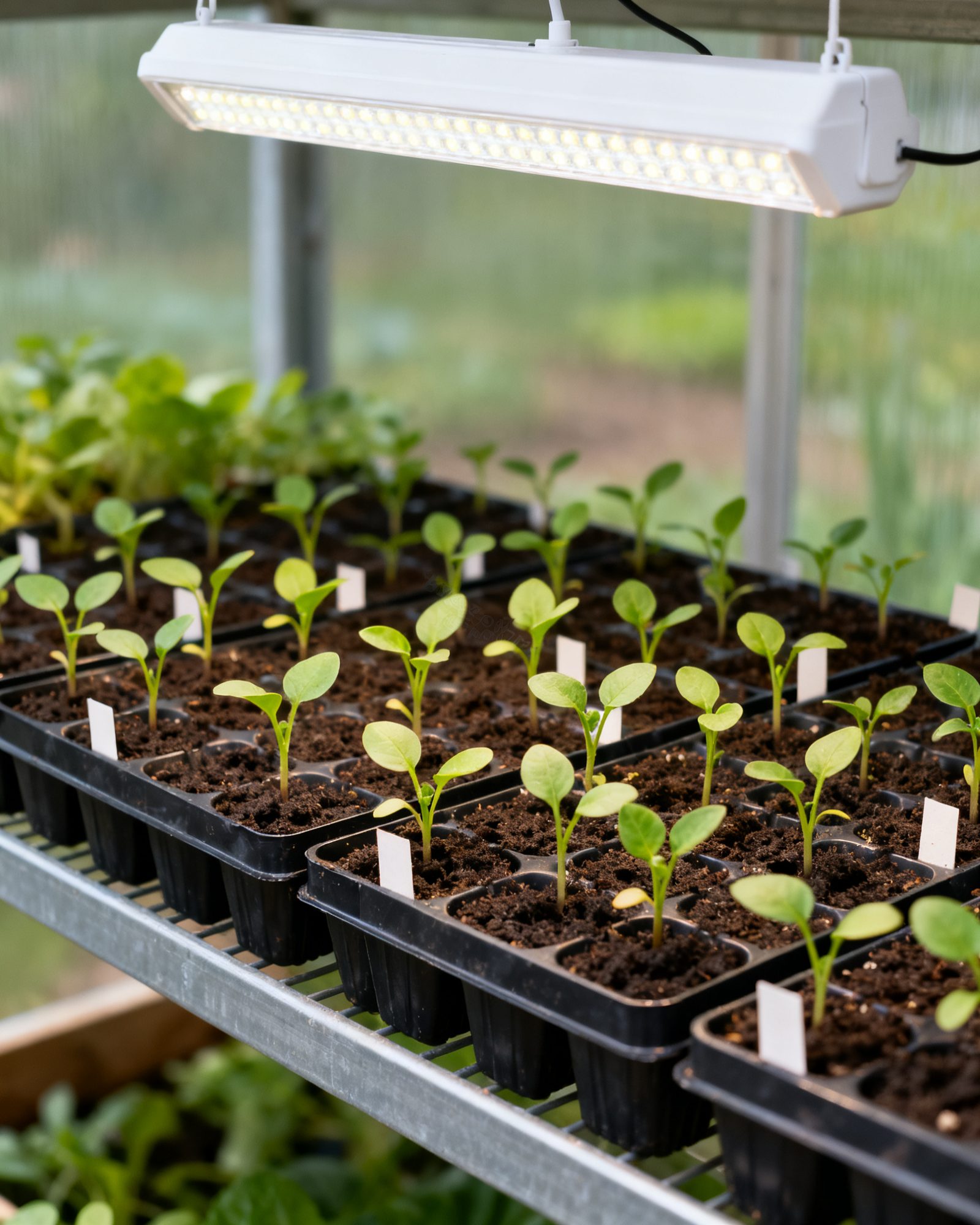
Seedlings die from kindness more often than neglect. The two kindest things a gardener does — watering often and feeding early — are the two most common ways to stall or kill a tray of young plants. Water when the top of the mix is nearly dry, not on a schedule; feed only after the first true leaves and only at the dilution on the label. Everything below follows from those two rules.
When to water seedlings
Feel the mix before you reach for the can. Wait until the top of the mix is nearly dry, then water thoroughly. That is the whole rule, and it holds whether the tray is in a cool basement or under lights in a warm room.
A schedule is the wrong tool because the mix dries at different speeds depending on temperature, airflow, cell size and how big the plants are. A tray that needed water only now and then at first may need it daily once the seedlings are up and the fan is running. Check with a finger or lift the container to judge its weight.
When you do water, water until it drains from the bottom of the container. A light surface sprinkle wets the top of the mix and leaves the root zone dry, which is worse than it looks: the roots stay shallow and the surface stays wet, the two conditions that favor disease.
Top watering versus bottom watering
Both methods work. Top watering from a can with a fine rose is quick and rinses the mix surface, but it can splash mix onto leaves and disturb small seeds. Bottom watering — setting containers in a shallow tray of water and letting the cells absorb it — keeps the foliage dry and pulls moisture up through the mix.
Clemson Extension’s practice for bottom watering is to fill a tray with 1 to 2 inches of water and let the cells absorb it for 3 to 10 minutes, then remove the containers. Do not leave them standing in water. A tray left full for hours keeps the mix saturated, which is the condition that kills roots.
Whichever method you use, the goal is the same: wet the whole root zone, then let air back into the mix before watering again.
Why saturated mix kills roots
Roots need oxygen as well as water. In a container, a mix that stays saturated has no air spaces left, and roots in waterlogged media are starved of oxygen. They stop growing, the plant stalls, and the lower leaves yellow. Wet mix also favors the water molds that cause damping-off, which can kill seeds before they emerge and collapse seedlings at the soil line.
The fix is cultural, not chemical: a soilless mix that drains, a clean container with holes, and a wet-then-dry cycle. Soilless mixes reduce soil-borne disease such as damping-off compared with garden soil, which is too dense in a container and may carry weed seeds and pathogens. If seedlings do collapse at the soil line, damping-off: why seedlings collapse and how to prevent it explains the sanitation steps and why infected plants cannot be saved.
A small fan near the seedlings, started around the two-true-leaf stage, makes stems sway and begins toughening them. It also dries the mix faster, so check moisture more often once the fan is on.
How long the mix feeds the plant
Most potting mixes carry enough fertilizer to grow a seedling for at least 6 weeks, and some labels say 6 to 8 weeks after germination. That means a seedling started in fresh mix does not need feeding at sowing or at germination, and young seedlings are easily burned by too much fertilizer.
Read the label on the mix you use. If it states a fertilizer charge, count from germination, not from the day you filled the flat.
When to fertilize seedlings
The earliest point to start feeding is when the first true leaves appear — the leaves after the pair of seed leaves, or cotyledons. Clemson Extension’s practice is to feed at every other watering with a water-soluble starter fertilizer, giving plain water between feedings.
Mix the fertilizer at the dilution on the label. Do not double it to catch up. Young seedlings are easily burned, and Maryland Extension notes that liquid fertilizer should be rinsed off the leaves. If you splash the foliage, rinse with plain water.
| Question | What to do | Why |
|---|---|---|
| When to water | When the top of the mix is nearly dry | Roots need air between waterings |
| How much | Until it drains from the bottom | A surface sprinkle leaves the root zone dry |
| Top or bottom | Either; bottom is 1 to 2 inches in a tray for 3 to 10 minutes | Keeps foliage dry, wets the root zone |
| When to feed | No earlier than the first true leaves (Clemson) | Most mixes carry enough fertilizer for at least 6 weeks (Maryland) |
| How strong | Label dilution, every other watering | Strong fertilizer burns young roots and leaves |
| On the leaves | Rinse with plain water | Seedlings are easily burned |
Watering after potting up
Seedlings moved to larger containers need the same wet-then-dry cycle, but the volume changes. A larger pot holds more mix and dries more slowly, so the interval lengthens. Water until it drains, then wait until the top is nearly dry again. Do not water on the old schedule out of habit.
Pot up shortly after the first true leaves appear for plants started together in a flat; tomato, pepper and eggplant started one per cell move up 2 to 3 weeks after germination. Hold seedlings by a leaf or the cotyledons, never by the stem. Potting up seedlings: when and how to move them to bigger pots covers the sequence and container sizes.
After potting up, keep the tops of plants 1 to 2 inches from the lights. A plant that stretches toward a distant fixture is a light problem, not a water problem, and no amount of watering fixes it.
What goes wrong
Overwatering. The most common mistake. Mix that stays wet, a tray left standing in water, or watering by the calendar rather than by feel all produce the same result: stalled growth, yellowing lower leaves, fungus gnats and, in the worst case, damping-off. Fungus gnats are mainly a sign of overwatering; let the mix dry and use yellow sticky traps to monitor. Products based on Bacillus thuringiensis var. israelensis are labeled for the larvae — follow the label.
Letting cells dry out completely. The opposite error, and it happens fast in small cells under lights. A seedling that wilts hard and recovers may still lose lower leaves. Check twice a day in warm, bright conditions.
Feeding too early. Fertilizing at sowing or before the first true leaves, or adding strong fertilizer to a mix that already carries a charge, risks burning tender roots.
Feeding too strong. Mixing fertilizer above the label dilution burns roots and leaf edges. Rinse any liquid fertilizer off the leaves.
Watering from above with a heavy stream. It displaces seed, splashes mix onto leaves and compacts the surface. Use a fine rose or bottom water.
Ignoring the fan. Air movement is part of the moisture plan. Without it, humid air sits over the tray and the mix surface stays wet longer.
A simple routine
- Fill clean containers with moistened soilless mix to within one inch of the top.
- Sow at the depth on the packet and cover with a clear dome until sprouts appear; remove it as soon as they do.
- Water when the top of the mix is nearly dry, until it drains.
- Once the first true leaves appear, feed at every other watering at label dilution; rinse leaves if splashed.
- Start a small fan at the two-true-leaf stage and watch moisture more closely.
- Pot up when seedlings crowd the cell, and keep the lights close.
If you are still assembling the setup — containers, mix, light, temperature and timing — how to start seeds indoors, step by step lays out the order. Watering and feeding are the part you repeat every few days; get the wet-then-dry cycle right and most other problems stay small.
Common questions
How often should I water seedlings indoors?
There is no fixed interval. Check the mix and water when the top is nearly dry, then water until it drains. Small cells under lights dry faster than large pots in a cool room, so check daily rather than following a calendar.
Is bottom watering better for seedlings?
Bottom watering keeps the foliage dry and wets the root zone evenly. Set containers in a tray with 1 to 2 inches of water for 3 to 10 minutes, then remove them. Top watering also works if you water until it drains and let the surface dry between waterings.
When should I start fertilizing seedlings?
Not before the first true leaves appear. Clemson Extension's practice is to start then, feeding at every other watering with a water-soluble starter fertilizer at the label dilution. Maryland Extension notes that most potting mixes carry enough fertilizer for at least 6 weeks, and some labels say 6 to 8 weeks after germination, so read the label on your mix.
Why are my seedlings turning yellow and stalling?
Yellowing lower leaves and stalled growth often mean the mix is staying too wet and the roots lack oxygen; in an older seedling whose mix has run out of fertilizer, they can also mean hunger. Let the top dry between waterings, make sure containers drain, and check for fungus gnats. If seedlings collapse at the soil line, suspect damping-off.
Can I use garden soil in my seed trays?
No. Garden soil is too dense in a container and may carry weed seeds and pathogens. Use a soilless seed-starting or potting mix, which drains better and reduces soil-borne disease such as damping-off.
Read next
Grow Lights for Seedlings: Distance, Hours and Setup
How far to hang grow lights above seedlings, how many hours a day they need, LED versus fluorescent, and the setup mistakes that leave plants leggy and weak.
Seed Germination Temperature, Domes and Heat Mats
Most vegetable seeds germinate best at 65° to 75°F. How to use domes and heat mats, when to remove the cover, and how to cool seedlings after sprouting.
How to Start Seeds Indoors, Step by Step
A practical, step-by-step guide to starting vegetable and herb seeds indoors: timing, containers, mix, warmth, light, watering, potting up and hardening off.